Delivery reconciliation
Digitizing and optimizing a manual supply-chain workflow within a TMS platform.

What you'll find in this case
About the project
Summary
Outcome:
Product
Date:
2023
My role:
Sole product designer
Team:
1 Business Analyst, 4 developers
Industry:
Logistics
What is delivery reconciliation?
In logistics, delivery reconciliation resolves discrepancies between what was dispatched and what was received—key to maintaining trust across the supply chain.
Common inconsistencies:
• Quantity mismatches.
• Divergences between carrier and customer reports.
The process usually involves cross-checking information, identifying the source of error, and making the necessary manual or system-based adjustments to ensure that the data is accurate and auditable.
Company context
The workflow relied heavily on manual steps, including pen-and-paper reconciliations and WhatsApp communication. There were no real-time updates or high-quality data records to support users or facilitate decision-making.
Opportunity
The absence of structured data and system support presented an opportunity to design for automation and real-time collaboration.
Who are the users?
Customer Service (CS) Team — Evaluates clients' complaints and logs reconciliation incidents, then forwards them to Last Mile Operations.
Last Mile Operations Team — Oversees delivery reconciliation efforts and coordinates with drivers.
Drivers — Responsible for delivering packages and conducting delivery reconciliations in the field.
01. Discovery
Understanding the current workflow
How it works
The reconciliation process was manual and fragmented: Customer Service logged incidents, Operations contacted drivers via WhatsApp, and drivers used paper forms to complete reconciliations in person. Proof was then sent back as photos, which Operations manually uploaded to a third-party system.
Key pain points:
• No real-time updates.
• Heavy reliance on informal communication.
• Prone to errors and information gaps.
The lack of a unified system made it difficult for different teams to work with shared information and follow a structured process.
The workflow also involved several decision points and edge cases—such as how to proceed if the driver was unreachable, unable to perform the reconciliation, or if deadlines were missed.

Current workflow presented to me by the Product Owner
Together, these factors made the process hard to scale, difficult to standardize, and emphasized the need for a dedicated module to consolidate data, streamline actions, and improve traceability.
01. Discovery
Problem exploration
To tackle this problem, I worked in parallel on two fronts: mapping a possible future workflow and building a Certainties, Suppositions, and Doubts (CSD) Matrix. This helped surface what we confidently knew, what needed user validation, and what required further investigation, guiding both the research approach and solution framing.
Future workflow

Future workflow: The highlight area displays the changes I proposed.
CSD Matrix

CSD Matrix
01. Discovery
User interview
Through structured interviews with the Customer Service team, Last Mile Operations team, and drivers, I gathered detailed insights into the entire process, which I organized into four key themes:
System & Process Requirements
Users needed a unified system with flexible initiation points, a mix of automated and manual status updates, and cross-team visibility to ensure coordination and traceability.
🎯 Design Impact: Shaped the information architecture to balance role-specific access with systemic cohesion.
Time & Deadline Management
Users needed precise deadline tracking, transparent audit trails, and support for special cases like calendar-based cities.
🎯 Design Impact: Led to robust status management and audit features to ensure accountability and SLA compliance.
User Behavior & Information Gaps
By identifying common reconciliation triggers, we created a pattern database in Metabase. We also made it possible to start reconciliation requests directly from the proof of delivery screen, making the process faster and more straightforward.
🎯 Design Impact: Supported data-driven monitoring of recurring issues and simplified the initiation of reconciliations.
Driver Experience (App-specific)
Reconciliations were integrated into drivers’ routes with real-time notifications and clear assignment to the original delivery driver.
🎯 Design Impact: Enabled a seamless driver app experience that seamlessly merges reconciliations with deliveries, enabling automatic routing and timely updates.
The interviews showed that, although the workflow looks linear, it actually varies depending on the role involved. This insight led us to design flexible components that could handle these differences without adding unnecessary complexity for users.
02. Definition
Organizing requirements
After organizing insights into key themes, we created a User Story Map to visualize the entire journey—from incident creation and ongoing monitoring by Customer Service, to work coordination by Operations, and ultimately resolution by the driver in the field. This process helped us align on user needs, uncover pain points across teams, and pinpoint the most impactful actions.

User Story Map
02. Definition
User flow
After mapping out the core actions across each stage of the workflow, I developed a detailed User Flow to visualize how different roles—Customer Service, Operations, and Drivers—interact with the system at each stage of the reconciliation process.

User flow
Collaborating closely with developers at this stage was essential to ensure that the proposed solutions were not only technically feasible but also scalable to support future process variations and increased operational volume. This alignment reduced rework and strengthened the foundation for efficient implementation.
03. Design
Prototyping
To validate the proposed solution, I developed a low- to mid-fidelity prototype that covered the main flows for each user type. I also prepared a structured testing script to guide users through key actions, ensuring we could observe task comprehension, usability, and potential friction points. Usability testing sessions were conducted remotely via Microsoft Teams, where users were invited to take control of my shared screen and interact directly with the prototype. For drivers, I tested mobile flows using Figma Mirror to simulate real-world usage more accurately.
1. Create reconciliation from delivery management screen
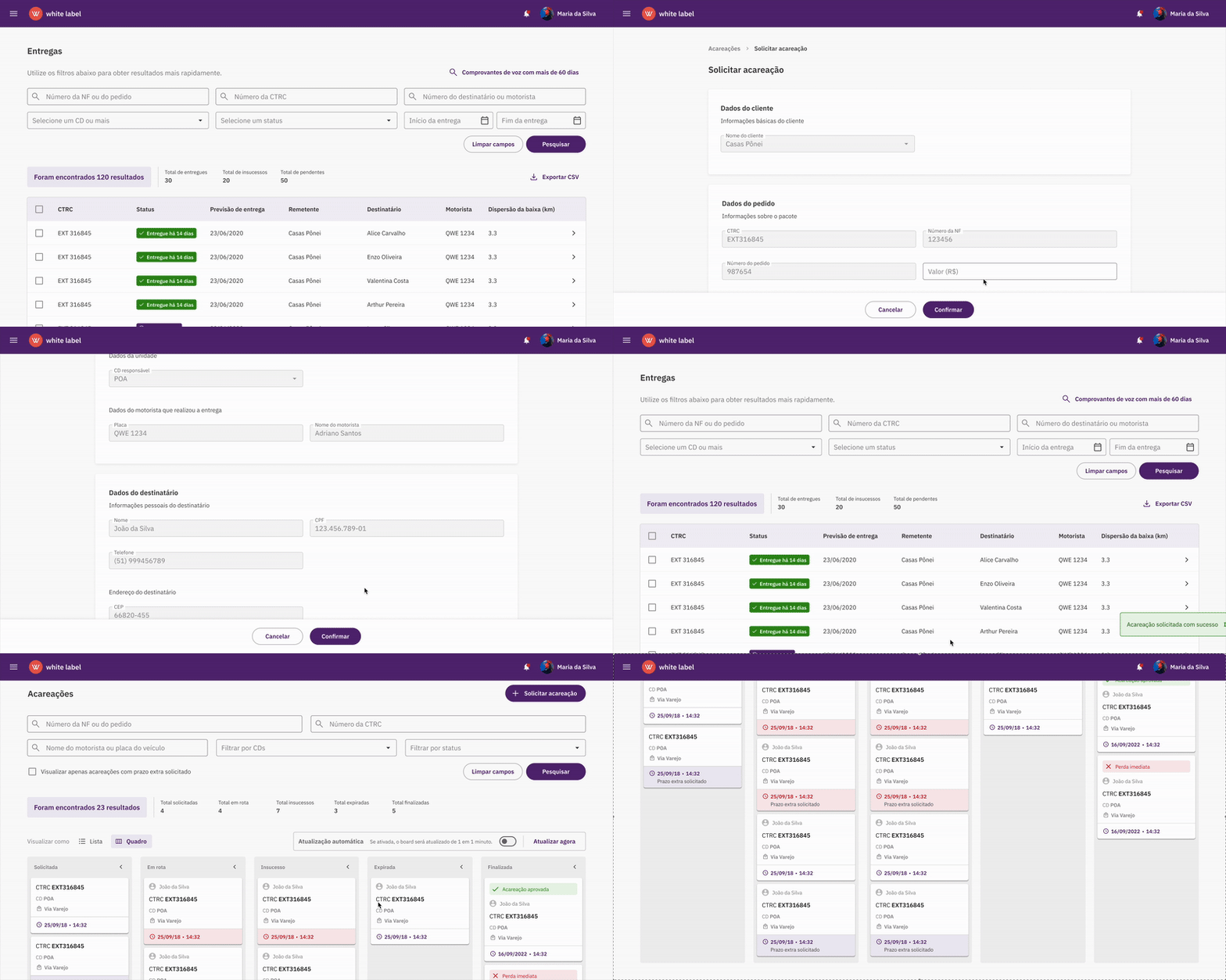
2. Create reconciliation from the new module
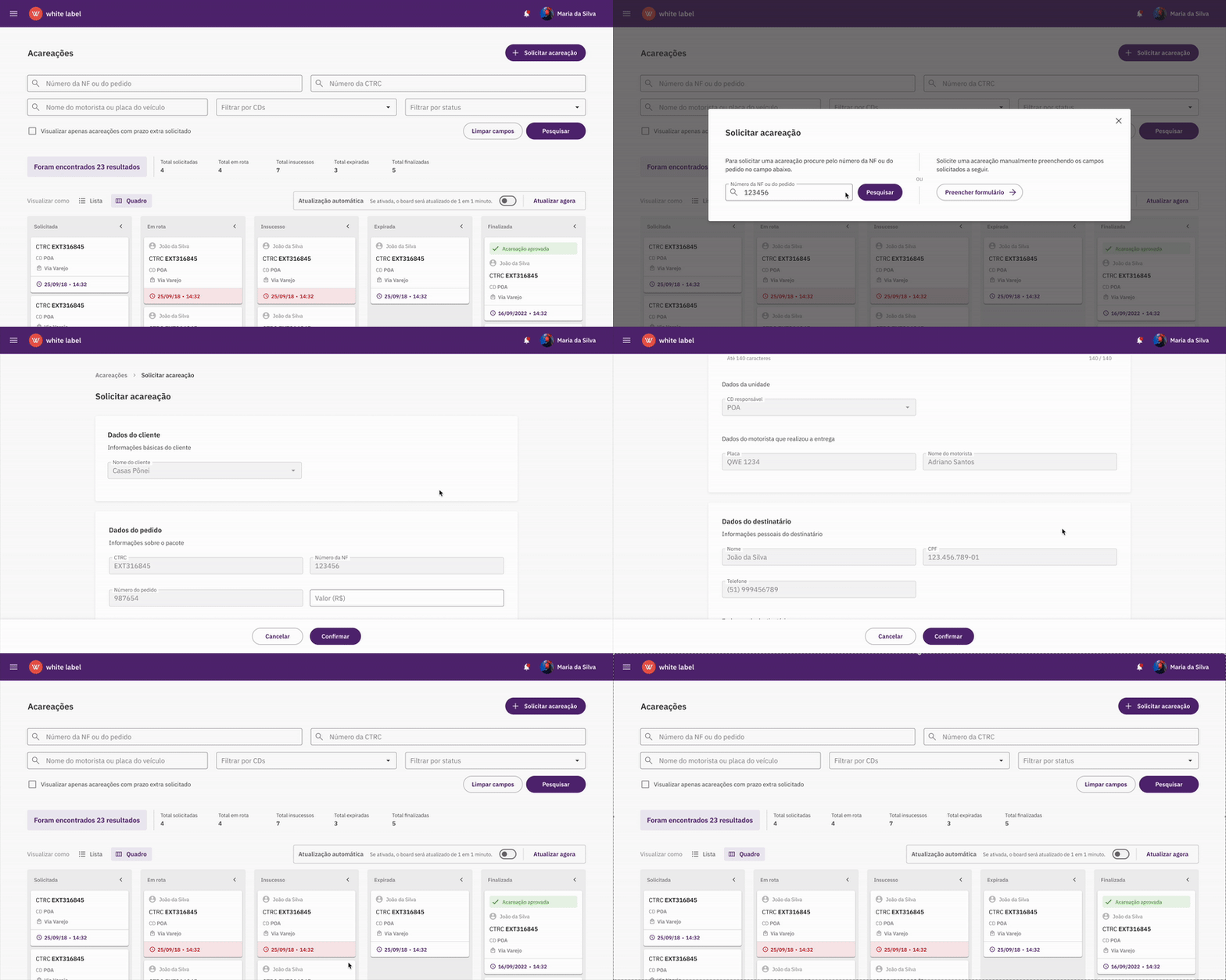
3. New module: Deadline and criticality

4. Routing alert for drivers

03. Design
Handoff
The design handoff involved:
• A structured design handoff that included detailed documentation in Figma.
• A kickoff session with the engineering team to walk through the solution.
• Alignment on priorities for the upcoming sprints.

An overview of how I usually organise handoff files.
03. Design
Iterating
Identified point
Initially, the process required the Customer Success team to manually update the case status after the driver completed the reconciliation. Although this step was requested by the users to ensure control, it eventually became clear that it introduced a bottleneck—slowing down the workflow and reducing overall efficiency.
Pivot
Through ongoing user feedback and observation post-launch, we identified this manual update as a consistent friction point. In response, we introduced an automated status update, allowing cases to close seamlessly once drivers completed their part of the process.
Design impact
This iteration showed how important it is to monitor solutions after they’re implemented and stay flexible as user needs change. It also revealed that safeguards can eventually turn into obstacles, reducing efficiency.
04. Metrics
Results & Monitoring
After launch, the feature achieved its main goal: helping the company collect structured data on the delivery reconciliation process. This new level of visibility allowed teams to monitor operations more effectively and gain insights into the performance of both dispatchers and drivers—something previously impossible with the manual, offline workflow.
However, the company wasn’t yet focused on product analytics, so I didn’t have access to behavioral data to assess how the feature was being used. Looking back, tracking engagement metrics such as adoption rates, active usage, and specific interaction patterns would have been essential. This information could have validated design decisions and informed future improvements based on real user behavior.
To wrap it up
Final notes
The Delivery Reconciliation feature closed a critical gap in the company’s logistics, turning a manual process into a streamlined, automated workflow. This reduced operational friction, improved efficiency, and empowered drivers, customer service, and operations teams to resolve issues in real time.
Although we lacked robust product metrics, moving to a structured digital process set the stage for future improvements. In hindsight, tracking adoption and usage data would have provided valuable insights to validate design decisions and refine the solution more quickly.
This project highlighted the value of designing around user needs, gathering continuous feedback, and staying flexible to ensure long-term success.